In retrospect, it appears my opinion on the Anthropocene Epoch being formalised was dubious from day one. In October, I questioned the impact of human activity on an epochal scale, and postulated that a much clearer stratigraphic signal might emerge in the decades or centuries to come. I still agree that we could be jumping the gun with making the Anthropocene an epoch now, and might benefit in waiting until a clearer signal becomes available for the start of this interval of time (e.g. Wolff 2014). Essentially, if the key environmental changes still lie ahead, then it is too early to conclude the base position of the Anthropocene now, even if current scientific evidence suggests stratigraphic evidence is significant (Waters et al 2014; Wolff 2014). Though I can see the use of the Anthropocene as a unit of time in human history, we must objectively question its utility for other disciplines ranging from stratigraphy to philosophy.
Onto the title of this blog: are we in the dawn or dusk of this unit of time? Wolff (2014) would likely argue we are in the dawn, living through a transition into this new epoch. Others might argue we are also in the dawn, but instead because the Anthropocene only began very recently (e.g. 1945 Alamogordo atomic test, 1950s Great Acceleration, 1960s radionuclide fallout spike). You might ask, 'how can we be in the dusk of an epoch that has only really just begun?', and I would say, what if it began at the same time of the Holocene, 11,700 years ago, or perhaps during early Neolithic agricultural expansion? I might also respond by saying we are at its dusk, because the Anthropocene could fade into non-existence before it ever really took off the ground. However, as of the new article on 8th January (Waters et al 2016; see here), it appears the AWG are leaning towards the opinion that we are in the dawn of this new epoch of time, with it beginning mid-20th century. If it becomes formalised later this year, consequently, we will have reached the end of the (very short) Holocene Epoch...
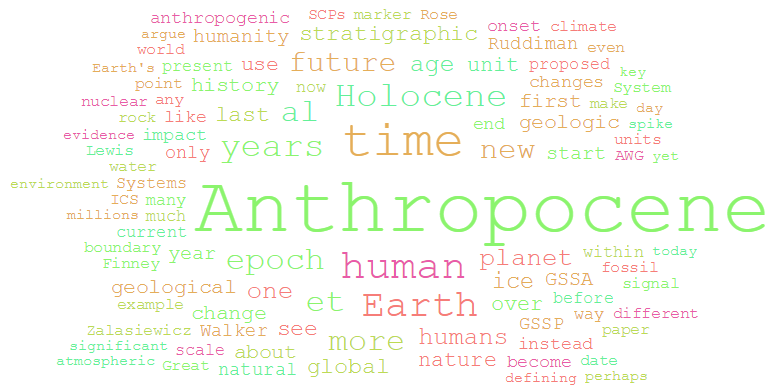 |
| Main topics and key words to take away from my blog! Clearly 'Anthropocene' stands out as most common, but others including 'human', 'Earth', 'time' and 'future' signify the diverse debates I have covered. |
Momentum is building for the Anthropocene, and a decision is set to be made this year. Will the Anthropocene join other epochs on the Geologic Time Scale, will it be downscaled to an Age in the Holocene, or will it be refused formalisation all together and remain an informal term? Regardless of the outcome later this year, the concept of the Anthropocene is undoubtedly here to stay and has made a phenomenal impact. There have been various new peer-reviewed journals set up in its name (e.g. 'Anthropocene' and 'The Anthropocene Review'), and over 1,080,000 search results on Google (this was actually ~700,000 when I looked yesterday, so mainstream interest is growing rapidly - perhaps due to the release of Waters et al (2016) paper).
I've realised the Anthropocene not only represents a paramount point in human and Earth history whereby humanity has become a global geologic force, but a point of change in the way we envisage our impacts on the planet. Unique in history, humans have become a central characteristic of the Anthropocene, but also the deciders of its fate. The decision of the AWG and ICS will not be easy, but it deserves every ounce of brain power, logic, and humility to make. Regardless of whether the Anthropocene is kept as an informal term or becomes formalised, the concept has opened up a vast new area of valuable research, shining a light on human impacts on our planet, and this research doesn't seem to be slowing down any time soon.
On a final note, I just want to say thank you to everyone who contributed to my blog by commenting and critically challenging my ideas week after week! This has been a truly wonderful experience which I shall look back upon fondly for a very long time. Farewell, my loyal readers.
Katy
